
Huntr Blog
20+ Career Advancement Strategies That Actually Move the Needle in 2026
March 23, 2026

Most career advice tells you to "work hard and stay positive." That's not a strategy, that's a fortune cookie. The career advancement strategies that actually move people from mid-level to senior, from overlooked to promoted, are specific, repeatable, and often counterintuitive.
We've worked with thousands of job seekers and career changers at Huntr. Here are the 20+ strategies that keep showing up in people who actually get ahead.
And when you are ready to start applying to new jobs, tailoring your resume with Huntr has been proven to get you more interviews. Check it out for free.
Looking to advance in your career?
Sign up for Huntr to create your resume, get instant feedback, and more to help you land a more senior role.
20+ Career Strategies for Career Advancement in 2026
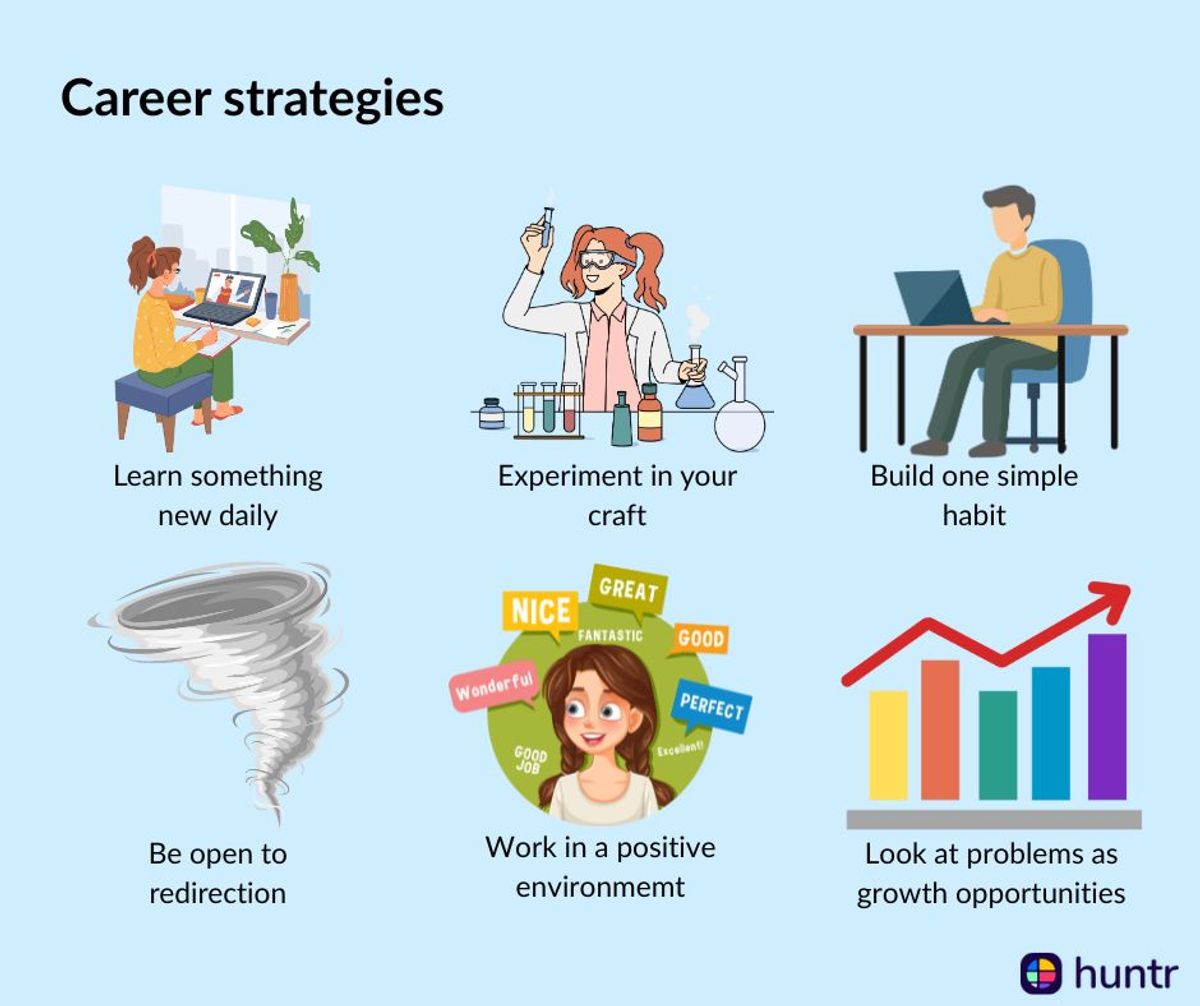
1. Learn something new daily
One career strategy to work on is learning something new each day. In your role, you should aim to learn something new by reading industry-related content, such as trends or tactics. Alternatively, you could read customer support emails to better understand what people like or dislike about your company’s product or service, and how to serve your audience better. An online course in your industry or field might help you think of new ideas or new ways of looking at problems. And starting a new hobby can help you forge new connections in your brain, boosting your creativity at work. Making learning an intentional daily habit can help you with your career advancement and your overall well-being. People often feel more fulfilled at work when learning new things.
2. Assess where you actually stand
Before you can advance, you need an honest picture of where you are. Look at your last 12 months of work: What did you deliver? What did you avoid? If your accomplishments are genuinely impressive but you're still not moving up, it's often because you're still indispensable at your current level — and no one has room to promote you out of it. Start delegating or documenting what you own so someone else can cover it. That's what creates space for a promotion.
3. Experiment in your craft
Don't just get better at what you already do; learn what the role above you requires. Read the job descriptions of senior roles you want. Watch what those people focus on in meetings. Take one course a quarter in a skill that bridges your current work and your next level. The people who get promoted aren't just the best at their current job; they're already doing pieces of the job above them.
4. Grow your LinkedIn network
One of the most crucial career strategies is to be more active on social media. If you're thinking of taking your career to the next level, you just need more people to know that you exist. Opportunities will come to you when people know where to find you. Applying for jobs is one way to be found, and actively posting on LinkedIn is a great way to get more of those senior roles to come to you. Share posts about your career, strategies, and talk about how to succeed in a role like yours to get more work to come your way. You can use a LinkedIn resume builder to help you turn your LinkedIn profile into a resume once you get a few opportunities in your inbox.
5. Ask for more feedback
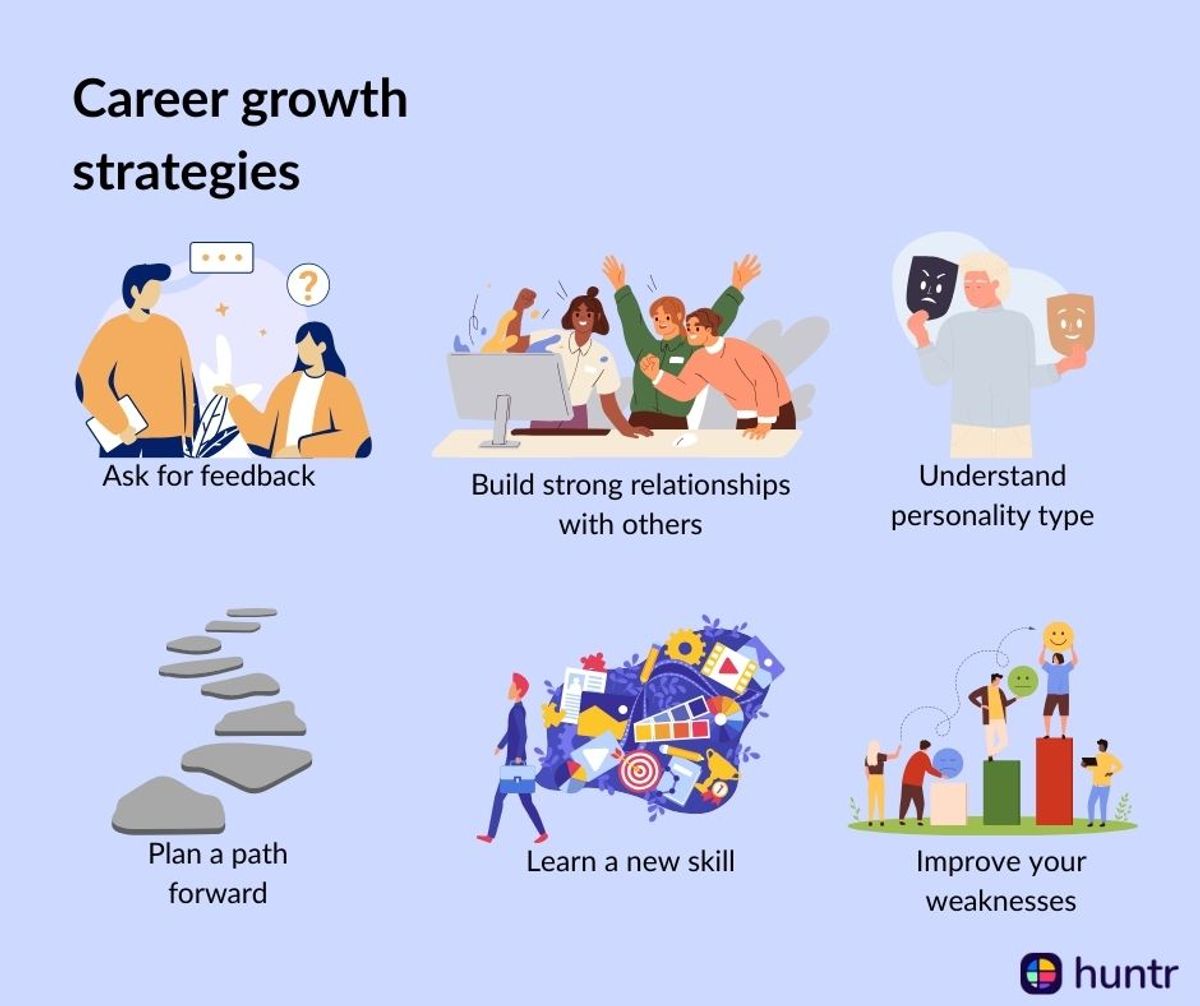
Most people wait for annual performance reviews to find out how they're doing. By then, it's too late to change the outcome. Ask your manager quarterly: "What's one thing I could be doing better?" Ask peers: "Is there anything you notice that I might be missing?" Feedback given before a decision is made is the only kind that actually changes anything.
6. Set goals for yourself
Having one big goal you’re working towards can help align your direction. Your goal might be to grow into a leadership role or to move into another career path. By knowing what you hope to achieve, you can create career strategies that align with that goal. For example, if your goal is to move into your first product manager position, you might start by taking a product manager course, networking with product managers, asking for more projects to work with developers, and more. Meanwhile, if your goal is to grow into a leadership role, you might start reading leadership books, taking a leadership course, mentoring people on your team, asking your manager for feedback on skills you need to develop to be a good manager, and practicing delegating responsibilities. Knowing the big goal can help you figure out the next steps you should take.
7. Learn more about leadership
As we've just mentioned, to land a leadership role, you need to consume more content about what it means to be a leader. You might also need to take some time to do informational interviews with leaders in your industry. So, if you work as a content marketer, you'd need to do informational interviews with content leads. If you're a content lead, you'd do informational interviews with content directors or heads of content. It's about getting as much information as possible. Take some time to look at the job descriptions for the senior roles you want to start working on, and develop those skills too.
8. Be open to redirection
Some of the best career moves look like failures in the moment. A role that doesn't work out, a pivot you didn't plan for, a company that folds. These are often the things that accelerate careers more than a straight-line path would. The people who advance fastest aren't the ones who execute a perfect plan. They're the ones who stay curious and opportunistic when the plan changes.
9. Look at problems as growth opportunities
Every problem that lands on your desk is a chance to demonstrate capability beyond your current level. When something goes wrong, be the person who maps out what happened and proposes the fix, not the one who distances themselves from it. Managers notice who runs toward problems and who runs away from them. That distinction determines who gets more responsibility.
10. Work on your soft skills
Many people are passed over for a promotion due to their soft skills. Do you communicate directly while still being sensitive to the people around you? Do you have a big ego, or are you humble in your accomplishments? Are you a team player, or are you in it for yourself? Promotions don't happen just because you're great at your job. They happen because you're great at your job, you're already doing the work of the role above you, and you're a great person to be around. Taking the time to develop and master soft skills will help you stand out from your colleagues and achieve the success you deserve.
11. Lift up the people around you
If you want to be seen as a leader, start acting like one before you have the title. Know what your teammates are working toward and actively help them get there. Celebrate their wins publicly. Offer your thinking when someone is stuck. The counterintuitive truth: people who focus on making the team look good get noticed far more than people who focus on making themselves look good.
12. Choose your environment carefully
Your environment determines your ceiling more than your ambition does. If you're in a role where learning is discouraged, feedback is rare, and politics matter more than output, that's not your problem; that's a context problem. The best career advancement strategy is sometimes changing the environment you're in. A good manager alone can accelerate your career by years.
13. Build strong relationships with others
Networking is one of the most powerful strategies for career advancement. With LinkedIn, your strong relationships can also take place online, not just within your company. While your coworkers see your work ethic, results, and attitude on a daily basis, you can grow an enormous network of people by actively posting on social media. Responding to comments and engaging with other people’s posts are great ways to connect with others. When you celebrate people’s wins online, they will notice. People often check to see what people have said on their posts, so they’ll remember you more. When using platforms like LinkedIn, aim to lift people up with supportive comments, praise, and appreciation. Beyond LinkedIn and the workplace, you can network with people at volunteer programs, networking events, philanthropy meetups, local events in your community, career-related Slack groups, and more. You never know who knows who, so avoid burning bridges and get to know people deeply.
14. Understand your personality type or key strengths
One career strategy you can try is taking a personality test like the Myers-Briggs or the Enneagram to find out your personality type. Once you know what your type is, you can discover job types that are a good fit for your personality, so you can navigate your career in that direction or so that you can grow into the type of role that's best suited for you. It's also good to identify your key strengths so you can lean into them more and put yourself in the spotlight for your career.
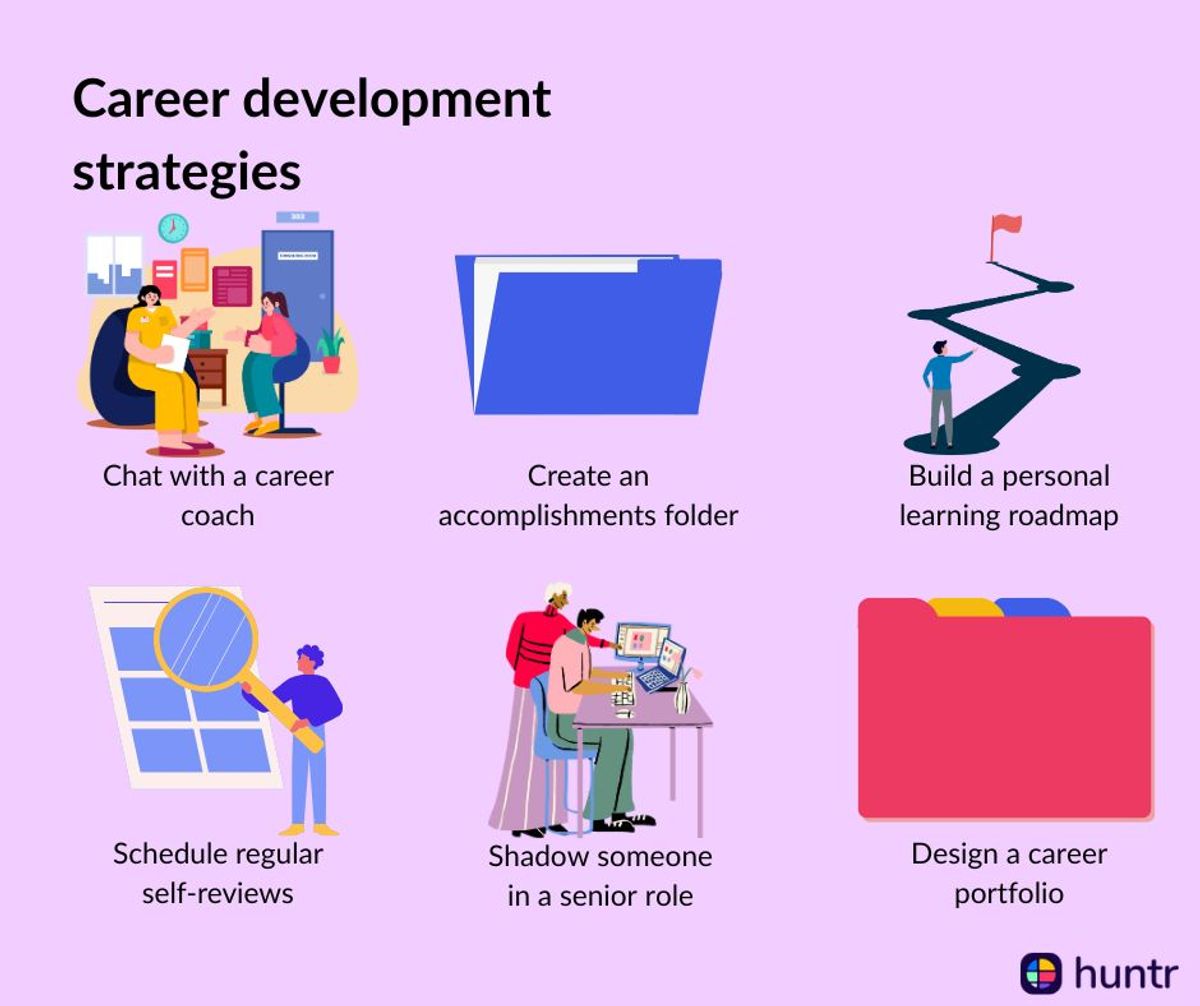
15. Chat with a career coach
One strategy for career development is to chat with a career coach. If you find yourself stuck in a job, salary range, or job title, you might connect with a career coach to come up with career strategies to help you break beyond that that are unique to you. By talking through your exact situation with someone, they might start to see the bad habits you have or how you think, helping you move beyond your current situation into your growth zone. Having a career coach or a mindset coach helps you build the confidence and skills you need to move to the next stage of your career and can be transformative for your growth.
If a career coach isn’t within your budget, you might choose to talk to your boss or a senior leader in your company to help you figure out what the blockers in your way are. Maybe your company isn’t growing fast enough, preventing your own career growth. In this case, you might consider looking for your next role. You can use a tool like Huntr to organize your job search, apply to jobs faster with autofill applications, and create an ATS-friendly resume and cover letter for free.
16. Plan a path forward
As you start to go through the career strategies in this article, you need to set a course for your career path. It's true that sometimes, even when we try our best, we can't move ourselves in the direction we want in the way we planned. Still, even if your career squiggles around a bit, you can still reach your destination. Plan out ways to win industry awards, build a name for yourself, and more to give you the career boost you deserve.
17. Learn a new skill with no expectations
Often, when we think about our career strategies, we build skills that have direct tie-ins. For example, a developer might learn a new programming language to expand their knowledge base. However, to boost creativity, networking opportunities, and more, consider learning a new skill that has nothing to do with your job. For example, if you work in marketing, you might sign up for a robotics course to learn how to build robots. Or if you’re a product designer, you might sign up for a pasodoble class to learn how to dance. Having a weird skillset beyond your job can make you more well-rounded as a person, forge new connections, and think about things from an unconventional perspective. Learning a skill for the sake of learning something new will be rewarding and give you a competitive edge from a mindset perspective.
18. Improve your weaknesses
Most people will tell you that you should double down on your strengths and outsource your weaknesses. This can be helpful in many cases, especially when it comes to execution speed. However, in practical terms, improving your weaknesses shouldn’t be outright avoided. Everything is learnable. You might have a blunt communication style that’s holding you back from your career advancement. Learning how to speak with more tact can be the deciding factor that propels you into your next leadership role. Sometimes, your weakness is holding you back on your path. Learning how to break beyond that can help you elevate to new heights.
19. Create an accomplishments folder
One of the easiest career strategies to implement this year is creating an accomplishments folder. This can be a folder on your desktop where you keep track of all your accomplishments. Alternatively, it could be a spreadsheet or a Google Doc. In this folder, you’ll add positive comments your coworkers have Slacked you, metrics you’ve personally hit, successes you’ve had, and any other data points you might need to help you when it comes time for a performance review. When your review is upon you, you can use direct quotes from colleagues about what they think of you. You’ll have actual data for what you’ve done. And so, when it’s time to negotiate that pay increase, you’re basing your impact on real numbers and feedback, which can help you with career advancement.
20. Look at problems as growth opportunities
People who are defeated by problems will often crumble when setbacks occur. Having problems or challenges in your career can actually be the reason why you climb to the top. When the company you're working at is struggling with something, you can channel your most creative and impactful ideas. Seeing someone turn something around is highly inspiring and rewarding. It’s not just about being on the ride when things go well. It’s really about how you’ll rise up when the odds are stacked against you. Changing your mindset when it comes to problem-solving and professional setbacks can be one of the most important career strategies, as it can be a great story of triumph you tell at your next job interview.
21. Learn something at the edge of your current role
Don't just get better at what you already do; learn what the role above you requires. Read the job descriptions of senior roles you want. Watch what those people focus on in meetings. Take one course a quarter in a skill that bridges your current work and your next level. The people who get promoted aren't just the best at their current job; they're already doing pieces of the job above them. Think especially about how AI might expand your work abilities.
How to Build Your Career Advancement Strategy
These strategies work best when you treat career advancement not as a series of individual moves but as a system. Pick three that address your specific situation right now: one habit to build, one relationship to deepen, and one skill to develop, and work them seriously for 90 days before adding more. Trying to do all of them at once is how you end up doing none of them.
If you're actively job searching as part of your career advancement plan, Huntr's AI resume builder and resume tailor help you position your experience for the roles you're targeting, not just the roles you've held.
Frequently Asked Questions
What is the most effective career advancement strategy?
The most effective career advancement strategy depends on what's actually holding you back. If you lack visibility, growing your LinkedIn presence and building relationships matter most. If you lack skills, a targeted learning roadmap is the priority. If you're doing great work but not being recognized, asking for more feedback and documenting your accomplishments is the lever. The mistake most people make is applying generic advice to a specific problem.
How long does career advancement take?
Most meaningful career advancement, a significant promotion or a successful role transition, takes 12 to 24 months of deliberate effort. The timeline shortens considerably when you have a clear goal, a mentor, and are actively doing work above your current level. It lengthens when you're waiting for advancement to happen to you rather than building toward it.
What's the difference between career advancement and career development?
Career advancement typically refers to moving up, getting promoted, taking on more responsibility, and increasing your seniority. Career development is broader; it includes growing your skills, expanding your network, and becoming better at your craft, even laterally. The best career development strategies support advancement, but they also make you more capable and resilient regardless of what your title says.
How do I advance my career when I feel stuck?
Start with an honest assessment of why you're stuck. Is it a skill gap, a visibility problem, a difficult manager, or the wrong environment? Each has a different fix. If it's a skill gap, build a learning plan. If it's visibility you're after, start posting and speaking up in meetings. If it's a manager problem, start building relationships elsewhere in the organization or outside it. If it's the wrong environment, the most powerful career move may be leaving.
Is it time to advance in your career?
Implementing these career strategies for advancement can help you improve your mindset, accomplishments, and network. If you’ve been thinking about switching roles to see a boost in salary or a change in job title, you can use Huntr to keep track of your interviews, apply to more roles faster, and create a resume and cover letter that books more interviews. Sign-up for Huntr today.

Nicole Martins Ferreira
Nicole Martins Ferreira, Product Marketing Manager at Huntr, brings a rich background in marketing and tech to craft insightful content on job search strategies and career advancement. With experience from Super Magic Taste to Shopify, she excels in creating engaging advice for job seekers. In her spare time, Nicole writes books, practices jiu jitsu, and builds robots as she loves learning new things.
Get More Interviews, Faster
Huntr streamlines your job search. Instantly craft tailored resumes and cover letters, fill out application forms with a single click, effortlessly keep your job hunt organized, and much more...
AI Resume Builder
Beautiful, perfectly job-tailored resumes designed to make you stand out, built 10x faster with the power of AI.
Next-Generation Job Tailored Resumes
Huntr provides the most advanced job <> resume matching system in the world. Helping you match not only keywords, but responsibilities and qualifications from a job, into your resume.
Job Keyword Extractor + Resume AI Integration
Huntr extracts keywords from job descriptions and helps you integrate them into your resume using the power of AI.
Application Autofill
Save hours of mindless form filling. Use our chrome extension to fill application forms with a single click.
Job Tracker
Move beyond basic, bare-bones job trackers. Elevate your search with Huntr's all-in-one, feature-rich management platform.
AI Cover Letters
Perfectly tailored cover letters, in seconds! Our cover letter generator blends your unique background with the job's specific requirements, resulting in unique, standout cover letters.
Resume Checker
Huntr checks your resume for spelling, length, impactful use of metrics, repetition and more, ensuring your resume gets noticed by employers.
Gorgeous Resume Templates
Stand out with one of 7 designer-grade templates. Whether you're a creative spirit or a corporate professional, our range of templates caters to every career aspiration.
Personal Job Search CRM
The ultimate companion for managing your professional job-search contacts and organizing your job search outreach.
Huntr
Blog Product Updates Resume Skill Guides Resume Examples Interview Question Guides Research 2025 Job Search Trends Report Affiliate Program Careers Privacy policy Terms of service Write for us LinkedIn Reddit r/HuntrCo Twitter @TryHuntr Email UsProduct
Job Tracker AI Resume Builder Resume Tailor Resume Checker AI Cover Letters Resume Summary Generator Resume Bullet Generator Resume Skills Generator Resume Headline Generator Resume Keyword Scanner Job Keyword Finder Targeted Resume Contact Tracker Interview Tracker Job Search Metrics Job Application Autofill Resume Storage AI Resume Review Job Clipper Resume Optimization ChatGPT Resume Builder Resume Fixer LinkedIn Resume Builder AI Resume Rewriter Interview Question Generator