
Huntr Research
Best Resume Format: What 94,338 Applications Reveal
Which resume format gets interviews? Huntr analyzed 94,338 applications to compare layouts, colors, templates, and more. See the findings and study limitations below.
It’s quite simple, virtually all resume formatting advice you have heard is wrong.
The best resume format for you makes your relevant experience easy to find and follows the employer's application instructions.
There are no hacks, no tricks, no “beat the ATS”. What matters is the quality of your content, not the format.
In Huntr's new study of 94,338 applications, neither single-column nor two-column resumes showed a reliable interview advantage. In fact, none of the resume formatting choices showed a meaningful impact on interviews.
The data-backed best practices are simple: Choose a readable template (easy for a human to read), check the upload, and tailor your resume to the role.
Job seekers lose hours to conflicting resume formatting rules. One column or two. Color or no color. Summary or no summary. Before you rebuild your resume again, it helps to ask if these changes actually make a difference. That is why we did this research.
Huntr matched resume formatting settings with outcomes recorded in our job tracker for 94,338 applications from 9,264 job seekers, covering October 2024 through April 2026. Of those applications, 5,422 reached a self-reported interview: 5.75%, or about 1 in 17.
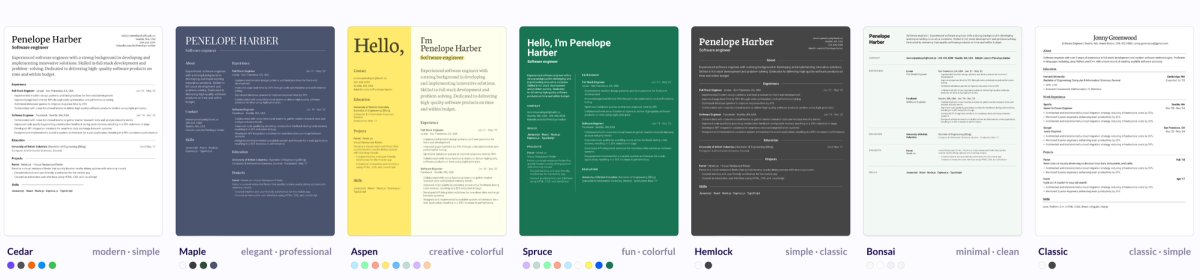
No single resume layout or template emerged as a reliable winner. The observed differences did not establish a consistent advantage for the formatting choices we could compare.
Actionable takeaway: Choose a clear format, check the application exported file, if you can, when sending your application, and spend more time explaining why your experience fits the job.
Separate evidence on tailoring your resume comes from our 2025 Annual Job Search Trends Report- More on that below.
This is original Huntr research using our own resume builder and job tracker and written by Sam Wright. The sample, analysis approach, and limits are explained in the methodology at the end.
Best resume format: key findings
These are observed interview rates in Huntr's October 2024–April 2026 sample. Raw differences are not proof that changing the format will change your results, you should see this as general trends.
| Formatting choice | Observed interview rate | What the study supports |
| Two columns vs. one column | 6.2% vs. 5.7% | No reliable layout advantage under the study's checks. |
| Accent color vs. plain palette | 6.3% vs. 5.6% | The gap did not persist in comparisons within the same job seeker. |
| Seven Huntr templates | 5.4%–7.3% | No reliable template winner; smaller samples have wider uncertainty. |
| Experience first vs. education first | 5.8% vs. 5.4% | No reliable difference by section order. |
| Font reduced by at least 1 point vs. default | 5.0% vs. 5.8% | The apparent disadvantage did not persist within the same job seeker. Although leans to supporting larger font size. |
| LinkedIn link vs. no LinkedIn link | 5.6% vs. 6.1% | No reliable advantage in either direction. |
This is observational research on resumes built in Huntr. It does not compare PDF with Word, test every ATS parser, or establish a winner among chronological, functional, and combination resumes. What it does, however, is support questioning whether resume formatting has any material impact.
Resume format can mean three different things: content structure (chronological, functional, or combination), visual layout (one column or two), or file type (PDF or Word). This report focuses on visual formatting and recorded outcomes. For how to organize and build your resume, use our guide to resume format types.
Single-column vs. two-column resumes: which gets more interviews?
Neither layout showed a reliable interview advantage in this study. Two-column resumes reached interviews on 6.2% of applications, compared with 5.7% for single-column resumes. The difference did not persist when we compared applications from people who used both layouts.
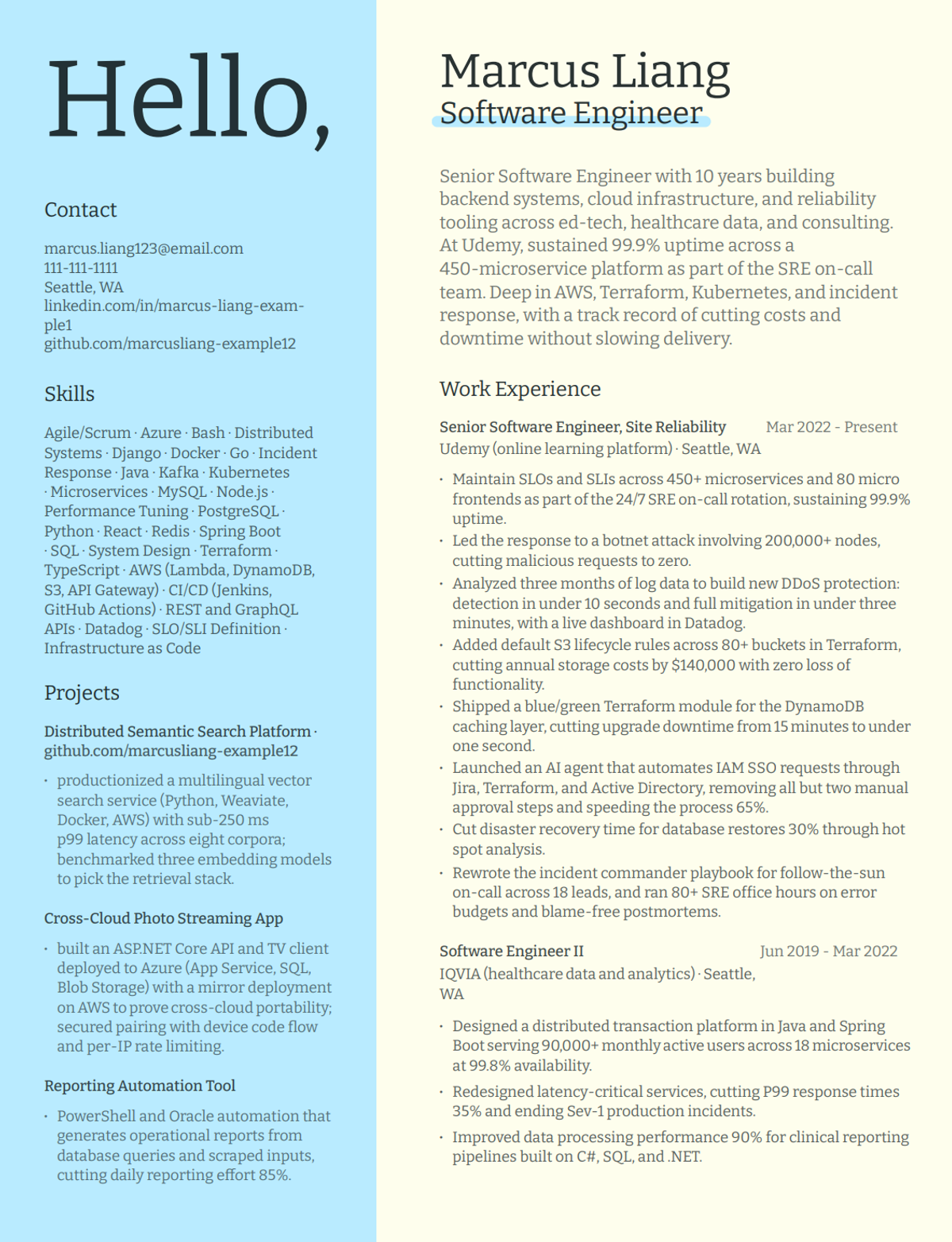
The sample includes 9,808 two-column applications. Those outcomes challenge a blanket claim that two columns prevent candidates from reaching interviews. They do not tell us whether every field was parsed correctly or whether a particular employer had trouble reading a file but they do show that we cannot say for sure that all two-column resumes are bad. But they also don’t show that the opposite is true either.
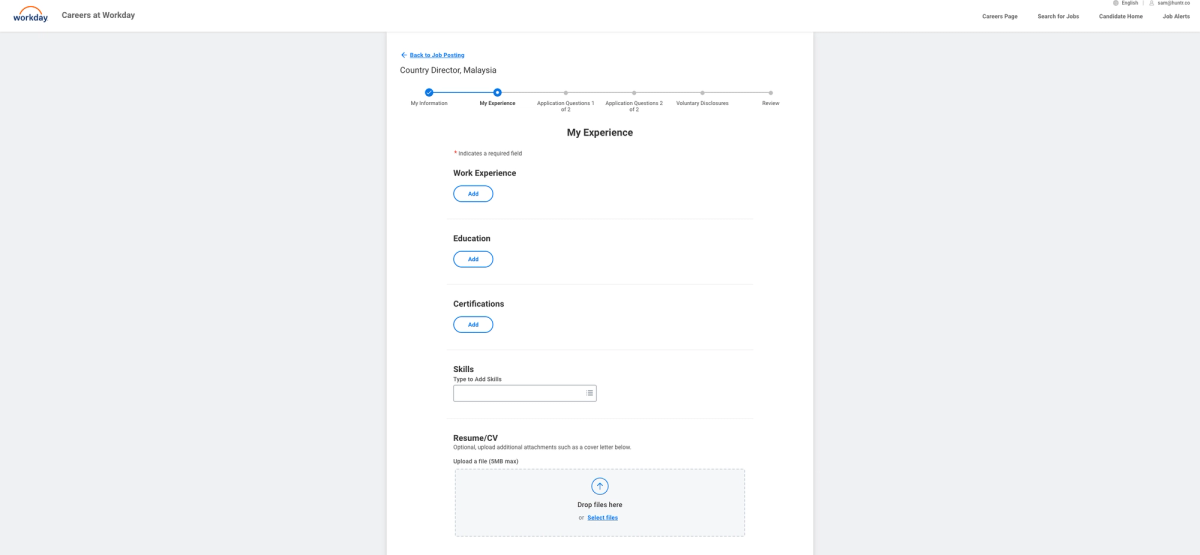
We also grouped applications by the site hosting the job posting to examine outcomes associated with named applicant tracking systems (ATS), including Workday.
Does Workday reject two-column resumes?
Two-column resumes reached interviews for jobs hosted on Workday in our sample. That is evidence against the idea that there is blanket rejection, but it cannot establish how every employer's Workday setup parses or screens a resume.
Huntr records where a job posting was hosted. We use that as a proxy for the ATS associated with the posting; we do not observe the actual submission route, employer settings, or rejection reasons.
For Workday-hosted jobs, we recorded 275 two-column applications from 134 job seekers. Twenty-five applications reached interviews, involving 19 people, and two reached offers. The observed interview rate was 9.1%, compared with 5.0% for single-column applications. The two-column sample is too small to support a claim that the layout performs better on Workday but certainly goes against the idea that two-columns are worse.
Observed interview rates for each identified ATS with at least 500 total applications in the sample. Application counts include both layouts:
| Posting host / ATS | Total applications | Single-column interview rate | Two-column interview rate |
| Greenhouse | 3,935 | 5.0% | 4.4% |
| Workday | 3,351 | 5.0% | 9.1% |
| Ashby | 1,628 | 6.3% | 5.8% |
| Lever | 1,233 | 5.7% | 4.1% |
| Oracle | 510 | 3.9% | 4.2% |
Two-column samples range from 24 to 387 applications per system. Both layouts reached interviews across all five posting hosts.
Parsing and rejection are different questions. Greenhouse's own documentation lists columned layouts among possible causes of parsing problems. It also explains that the resume remains attached to a candidate's profile when automatic field extraction fails. Our outcome data and that warning can both be true: a resume can reach an interview even when some details need manual correction.
Does color on a resume affect interview rates?
We found no reliable advantage or disadvantage from the color palettes we compared. Resumes with color reached interviews on 6.3% of applications, versus 5.6% for plain palettes; the gap did not persist within the same job seeker. This does not test every color combination. Keep body text easy to read and use color as an accent.
Do you need a resume summary?
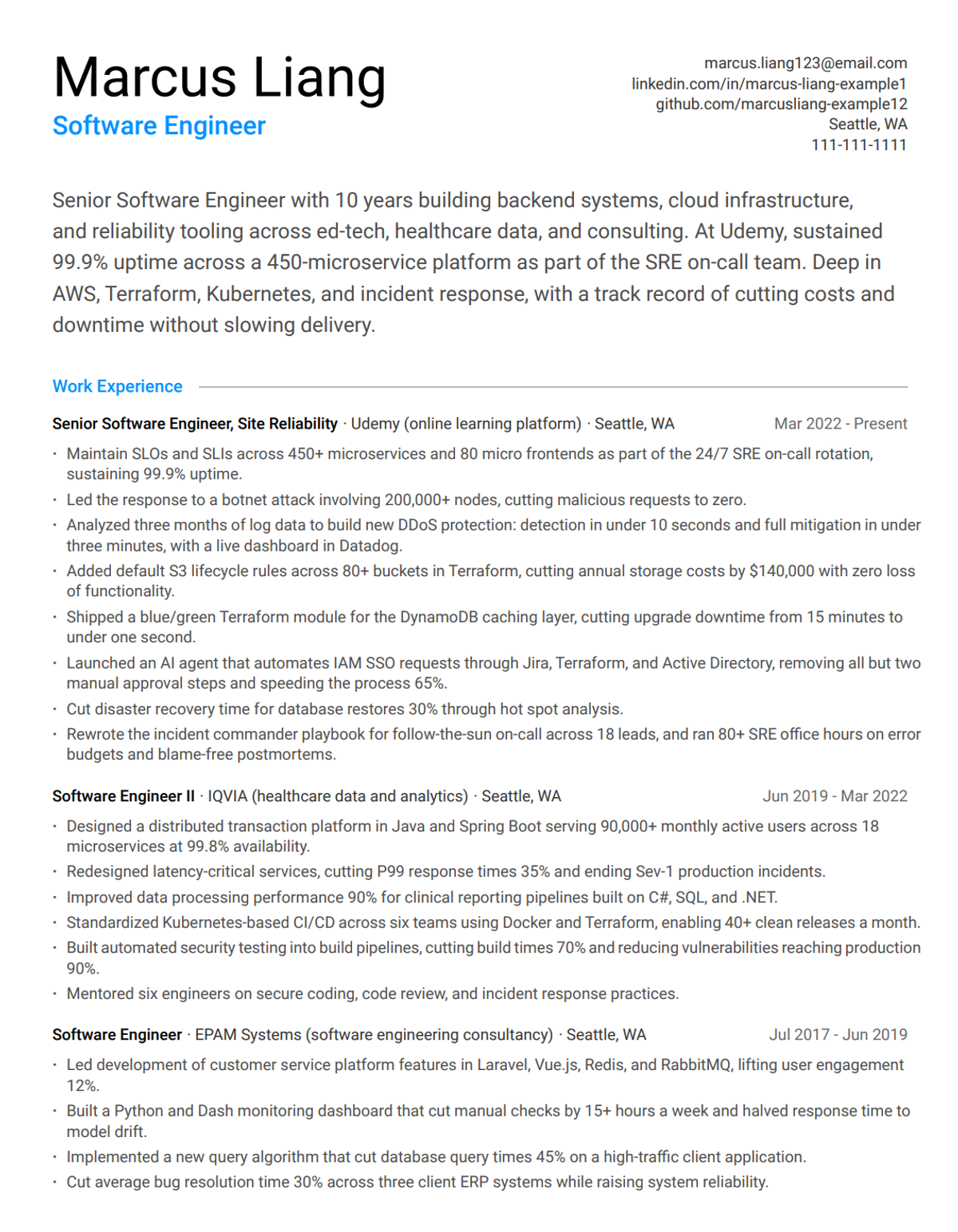
A resume summary is optional: this study found no reliable interview advantage from including or removing one.
Resumes without summaries initially appeared to get more interviews, but people who removed summaries also submitted fewer applications. After comparing applicants at similar application volumes, the apparent summary advantage did not persist. That does not tell us whether a particular summary was useful.
Keep a summary if it quickly explains your fit for the role, especially when your background needs context eg. when you are changing careers or industries. Make it earn the space with a relevant achievement or qualification; skip generic adjectives that could describe anyone.

Which Huntr resume template performed best?
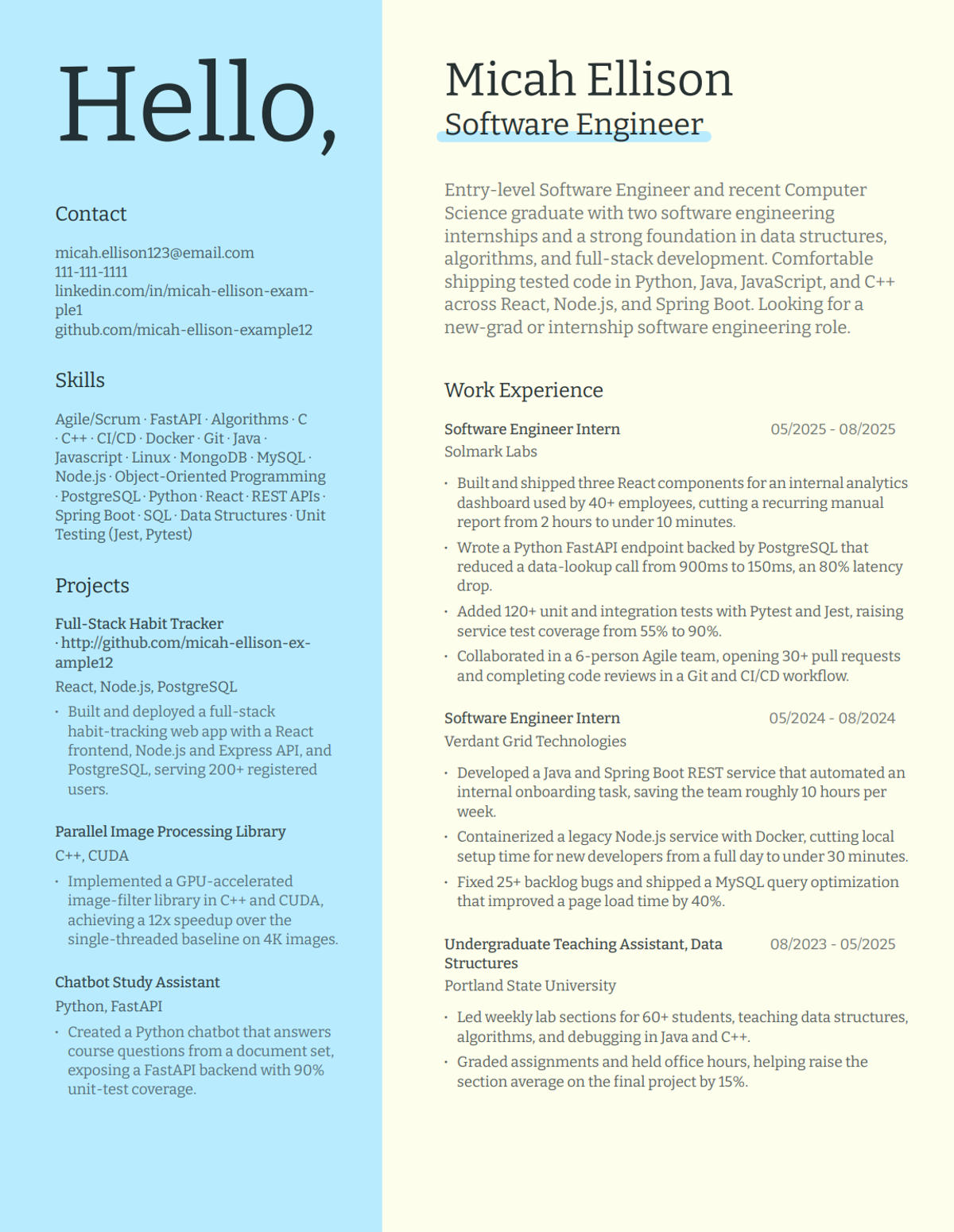
Aspen had the highest raw interview rate at 7.3%, but no template emerged as a reliable winner under the study's checks. Here are the observed rates for all seven templates, October 2024 through April 2026:
| Template | Layout | Applications | Interview rate |
| Aspen | two column, colorful | 628 | 7.3% |
| Hemlock | single column | 10,386 | 6.6% |
| Cedar | single column | 13,628 | 6.4% |
| Bonsai | two column | 4,067 | 6.3% |
| Maple | two column | 3,744 | 6.1% |
| Spruce | two column, colorful | 1,369 | 5.4% |
| Classic | single column | 60,516 | 5.4% |
These figures describe different groups of applicants, not a randomized template test. Smaller samples produce wider uncertainty: Aspen has 628 applications, while Classic has 60,516. Classic is also the default, so its users may differ from people who actively choose another design. Choose the template that presents your content clearly and remember that the raw ranking is not a prediction of your results.
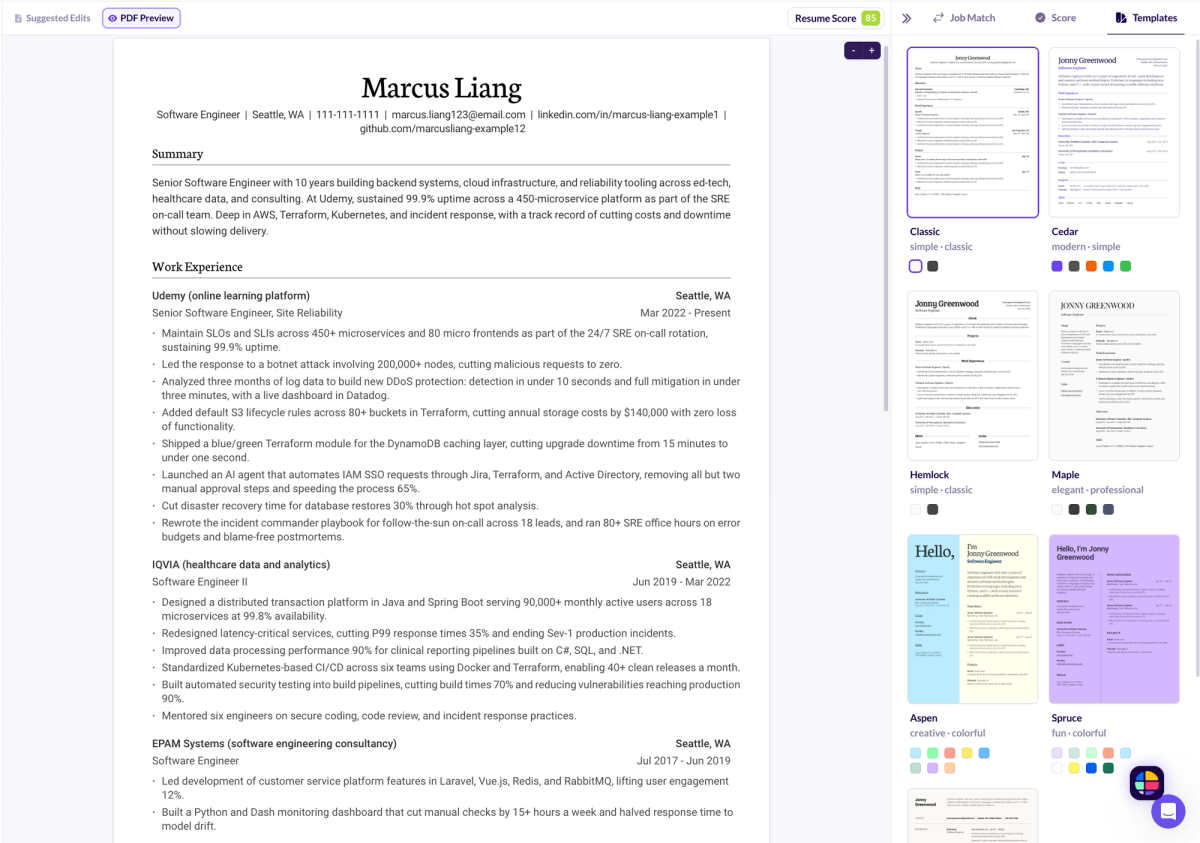
Does using a recognizable template make me look unoriginal?
Using a template did not prevent job seekers in this sample from reaching interviews. But we did not measure whether recruiters recognized a template or how they judged originality.
Should education or experience come first?
We found no reliable difference: experience-first resumes had a 5.8% interview rate, compared with 5.4% for education-first resumes. Lead with the section that best supports your application. That may be recent relevant work, or education and projects if you are just starting out.
What resume font and font size should you use?
This study cannot identify a best resume font because the dataset does not record font family. Template-level outcomes do not isolate the effect of a typeface. Use a clear, familiar font and check that the exported resume is comfortable to read at normal viewing size.
Applications with fonts reduced by at least one point had a 5.0% interview rate, compared with 5.8% at the default size. That apparent disadvantage did not persist within the same job seeker. However, the finding supports that tiny text is not a good idea: shorten repetitive content before shrinking the font, and use another page when relevant experience needs the space. We found that two-page resumes perform well for most candidates. The content matters more than length.
How should you format dates on a resume?
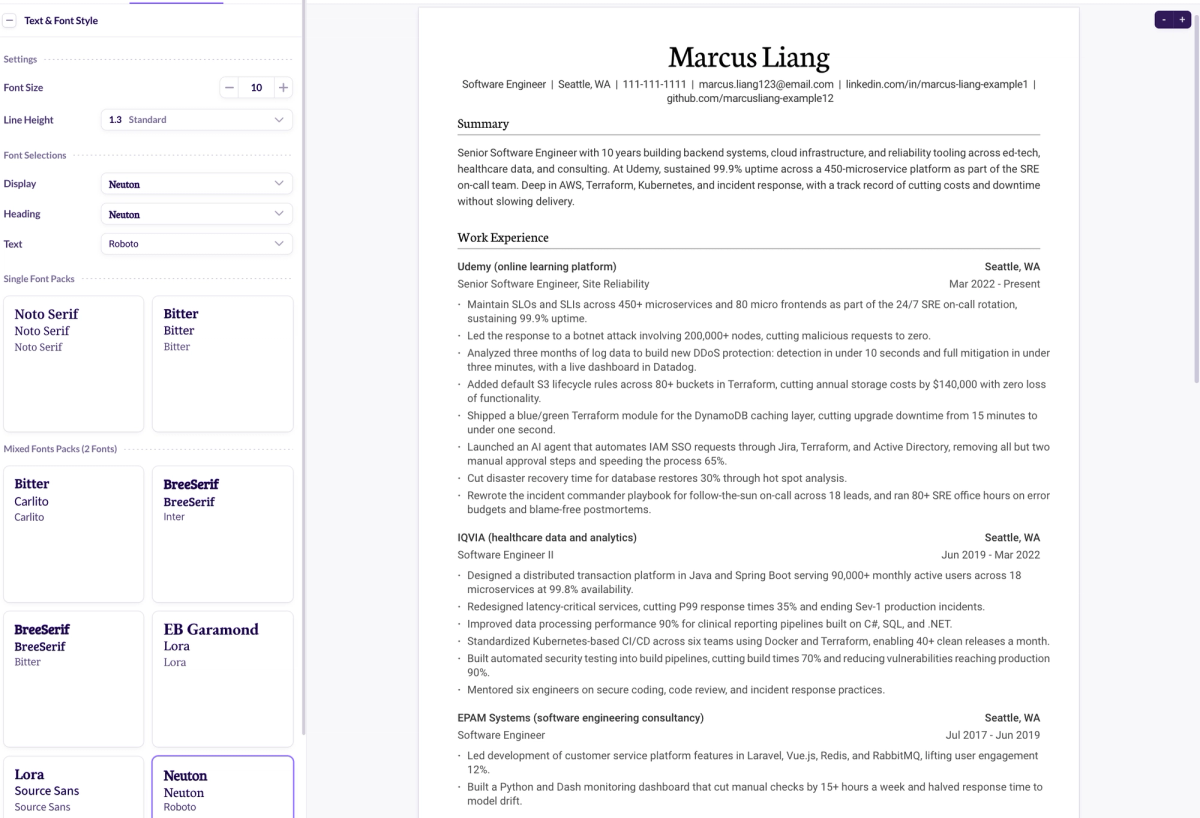
We found no reliable interview advantage among the date formats compared. Choose one consistent style, such as "Jan 2024–Mar 2026," and make the dates easy to match to the right job. This study does not establish a best date alignment.
Should you use standard resume section headings?
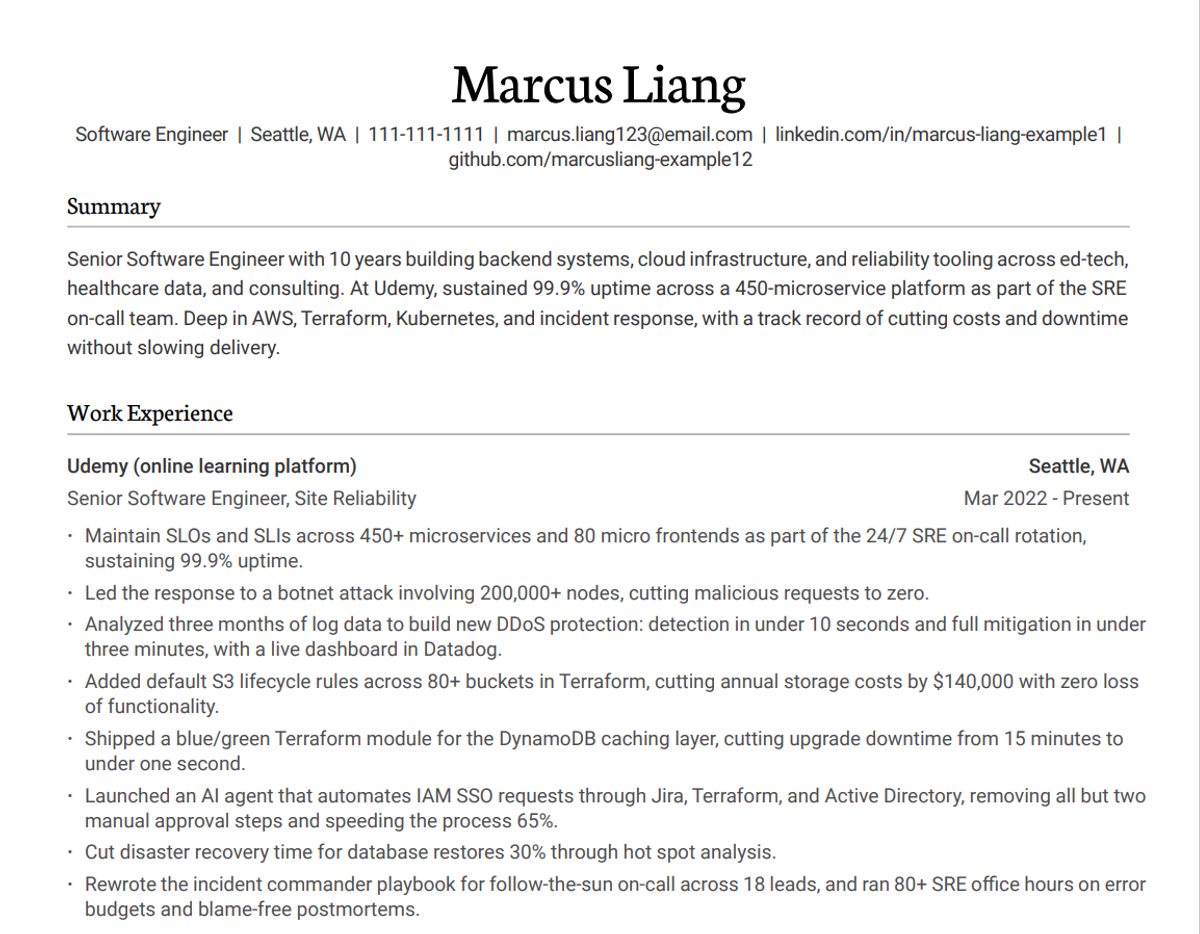
Use clear headings such as Work Experience, Education, and Skills. Our dataset records section types, not the custom labels people give them, so it cannot compare "My Journey" with "Work Experience." Conventional labels are practical guidance for clarity, not a result proven by this study.
Are headshots, logos, skill bars, or icons okay?
This study cannot compare outcomes for headshots, logos, skill bars, or icons. Headshots were not recorded, and Huntr's templates do not use skill bars or icons. Put essential qualifications in text, describe skills through actual work, and follow the expectations of the role and country when deciding whether a photo belongs. Huntr’s templates all offer the ability to add a photo, as this is culturally appropriate in certain countries.
Is PDF or Word better for a resume?
Follow the employer's requested file type first. If PDF is accepted, a text-based PDF is a practical choice for preserving your layout. All resume exports in this study were PDFs, and 5.75% of the matched applications reached interviews. Because there was no Word comparison group, the study cannot show that PDF performs better than DOCX. There is no known evidence to support the claim that PDF perform worse than Word.
How can you check your resume after uploading it?
Check the file preview and any fields the application form fills automatically. Confirm that your name, contact details, employers, job titles, and dates are correct. Copying text from your exported resume into a plain-text document can also reveal missing text or an unusual reading order. That is a useful check, not a guarantee of how an employer's ATS will parse it. You can also upload your resume to Huntr’s own tool for free to see how it parses your resume. This is not the exact technology of other ATS but may give you some indication of parsability.
Should you include LinkedIn, portfolio links, and location?
The difference was not reliable and changed direction between analyses, so the study gives no reason to add or remove LinkedIn solely to improve conversion. Include current links that help demonstrate your work. Our real resume examples by role can help you judge whether a portfolio, project, or GitHub link adds useful evidence. Show your actual city and region when location is relevant, and state remote-work preferences separately.

Does the best resume format differ by country?
This study does not establish the best resume format for every country. Most resumes lacked country information. The US and Canadian layout comparisons followed the overall pattern, but that is not enough for a global recommendation. Check the employer's instructions and local expectations for photos, personal details, and CV length.
How to choose a resume format and focus your effort
Choose a format that makes your evidence easy to find, then focus on relevance. In the separate 2025 Annual Job Search Trends Report, tailored applications had a 5.8% conversion rate to interviews, offers, or hires, versus 3.73% for untailored applications: about 1.6 times as high.
Use this checklist before sending your next application:
- Follow the job posting's instructions for file type, required information, and submission.
- Choose a readable template with clear section headings and a visible work history.
- Keep the achievements and qualifications that best match the role; remove repetition.
- Check the exported file, links, text order, and any automatically filled application fields.
- Track the outcome so you can review your applications with evidence, not just formatting advice.
Build a clear resume. Make the content count.
Use Huntr to organize your experience, tailor your resume to a job, and track what happens after you apply.
Study sample: 94,338 applications from 9,264 job seekers
The analysis uses an August 2026 data snapshot. We started with 466,711 resumes built in Huntr, including 292,811 tied to a specific tracked job. We retained the latest resume version per job, required an applied status, and used an April 30, 2026 application cutoff to allow outcomes time to develop. The resulting sample covers October 2024 through April 2026: 94,338 applications from 9,264 job seekers, with 5,422 recorded as reaching an interview (5.75%).
Interview rate means applications recorded as reaching an interview divided by applications in the relevant group. Outcomes come from stages job seekers logged in their own trackers. Posting hosts were matched against 169 known job sites, including 56 ATS platforms; the named-ATS table includes only platforms with at least 500 applications.
Methodology and limitations
We used three checks to reduce the chance of mistaking differences between applicants for differences caused by resume formatting.
First, account for repeated applications. One person's 40 applications are not 40 independent observations. Our uncertainty estimates account for applications grouped within the same job seeker.
Second, compare similar groups. We examined formatting comparisons within role and application-volume groups, because job targets and application behavior can differ between people who choose different formats.
Third, compare within the same person. Where job seekers used both versions of a formatting choice, we compared their outcomes across those versions. Those comparisons help reduce differences between people, but they do not control every difference between jobs or applications.
The study's decision rule required a finding to survive all three checks and a correction for multiple comparisons across these questions. None of the tested formatting differences met that threshold. "No reliable difference" means the analysis did not establish an advantage; it does not prove the true effect is exactly zero.
Important Limitations: This is observational data from Huntr users, not a randomized experiment or a representative sample of all job seekers. Outcomes are self-reported. We cannot verify the exact file submitted, the employer's upload screen, parser output, screening settings, or reasons for rejection. We do not record font family, margins, custom section titles, or headshots, and all resume exports are PDFs. Some questions therefore have practical guidance rather than a measured comparison. Differences in job fit, seniority, employer, timing, or application behavior may still influence the results.
Questions about the data or requests for cuts we did not publish?
Email: [email protected].
Get More Interviews, Faster
Huntr streamlines your job search. Instantly craft tailored resumes and cover letters, fill out application forms with a single click, effortlessly keep your job hunt organized, and much more...
AI Resume Builder
Beautiful, perfectly job-tailored resumes designed to make you stand out, built 10x faster with the power of AI.
Next-Generation Job Tailored Resumes
Huntr provides the most advanced job <> resume matching system in the world. Helping you match not only keywords, but responsibilities and qualifications from a job, into your resume.
Job Keyword Extractor + Resume AI Integration
Huntr extracts keywords from job descriptions and helps you integrate them into your resume using the power of AI.
Application Autofill
Save hours of mindless form filling. Use our chrome extension to fill application forms with a single click.
Job Tracker
Move beyond basic, bare-bones job trackers. Elevate your search with Huntr's all-in-one, feature-rich management platform.
AI Cover Letters
Perfectly tailored cover letters, in seconds! Our cover letter generator blends your unique background with the job's specific requirements, resulting in unique, standout cover letters.
Resume Checker
Huntr checks your resume for spelling, length, impactful use of metrics, repetition and more, ensuring your resume gets noticed by employers.
Gorgeous Resume Templates
Stand out with one of 7 designer-grade templates. Whether you're a creative spirit or a corporate professional, our range of templates caters to every career aspiration.
Personal Job Search CRM
The ultimate companion for managing your professional job-search contacts and organizing your job search outreach.
Huntr
Blog Product Updates Resume Skill Guides Resume Examples Interview Question Guides Research 2025 Job Search Trends Report Affiliate Program Careers Privacy policy Terms of service Write for us LinkedIn Reddit r/HuntrCo Twitter @TryHuntr Email UsProduct
Job Tracker AI Resume Builder Resume Tailor Resume Checker AI Cover Letters Resume Summary Generator Resume Bullet Generator Resume Skills Generator Resume Headline Generator Resume Keyword Scanner Job Keyword Finder Targeted Resume Contact Tracker Interview Tracker Job Search Metrics Job Application Autofill Resume Storage AI Resume Review Job Clipper Resume Optimization ChatGPT Resume Builder Resume Fixer LinkedIn Resume Builder AI Resume Rewriter Interview Question Generator